


Marshall stresses that reforestation must be done in collaboration with those directly affected; after all, there was usually a human reason why the forest was cut down or degraded in the first place. “If people need to feed their families that’s massively more important than whether a monkey in the tree is not going to have a place to sleep that night,” he says.
At the local level, Keijzer says, simply planting trees is not enough. The forest economy should be designed to benefit residents. This might mean building woodlots for local use, planting exotic species that grow faster and are worth more money alongside native ones, or creating nature reserves with associated tourism jobs. With a sustainable local economy, Keijzer says, people will be less likely to cut down all the trees in order to simply make ends meet.
Keijzer’s organization, WeForest, is now working with the U.N. Food and Agriculture Organization to create a formal standard in forest landscape restoration, which will include considerations such as forestry and the livelihoods of local people.
But engaging communities in this work can also provide more than material benefits, according to Andrew Heald, technical director of the Confederation of Forest Industries, or Confor, a U.K. forest industry association. Reforestation schemes that involve local communities can help reconnect people with nature, he says, describing tree planting as a “real kind of statement of optimism in the future of something.”
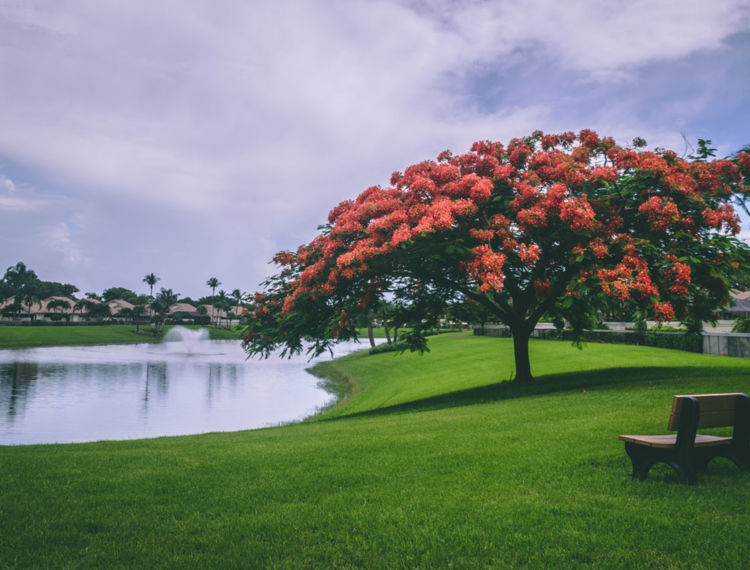
The Amazon Rainforest, for example, which absorbs roughly 2.2 billion tons of CO2 annually—about 5 percent of all global carbon emissions—has lost 17 percent of its area over the past 50 years to human encroachment. The commentary on nature-based climate solutions published in June in Nature Climate Change warned that half of the Amazon Basin’s tree species could be lost by 2050 due to a combination of climate change and deforestation for cattle grazing, soy farming, and timber. And that doesn’t take into account the nearly 5 million acres that burned this past summer.
Roberto Palmieri, deputy executive secretary of Brazilian forestry institute Imaflora, is particularly concerned by the recent blazes, which were mostly the result of cattle ranching. While a deforested area can be restored relatively quickly, with fire “you kill all the life in this place, even underground, the microorganisms inside the soil,” he says. “So, wow, a lot more time.” A recent study in Scientific Reports raised serious concerns about the Amazon’s ability to sustain itself in the longer term, with evidence that deforestation was decreasing the forest’s moisture levels.
Regardless of how international funding and local resources are brought to bear, a clear focus on smart reforestation which balances benefits to humans and the wider environment is essential because the future for major forests around the world looks increasingly bleak.
But Palmieri is optimistic, pointing out that there have been successful restoration projects in the Amazon, both national ones that have prioritized agroforestry and internationally-funded ones that have sought to restore biodiversity. “What’s nice [is] we have a lot of concern now. We also have a lot of technology. You know how to restore that area, you have a lot of assistance to do so,” he says. “I think the whole planet is looking.”
“2.1 billion people worldwide lack safe drinking water at home. I am proud to say that we are coming together once again this year to reduce that staggering number. When I first started One Drop, I wanted to approach fundraising in an unexpected and innovative way, and this is exactly what One Night for One Drop has become. It is a different type of event where we all meet to have fun and share our common desire to help others and make the world a better place,” says Guy Laliberté, One Drop, Cirque du Soleil and Lune Rouge Founder.
One Night for One Drop is not a traditional fundraising event. The evening begins with an intimate pre-show cocktail reception followed by a blue carpet filled with celebrities and guests. Prior to the R.U.N performance, a live auction spotlighting once-in-a-lifetime experiences and unique luxury items will be presented in the R.U.N Theater.
With a creative team including award-winning Director Robert Rodriguez (Alita, Sin City, From Dusk till Dawn), Show Director Michael Schwartz and Music Composer Tyler Bates, R.U.N is an unprecedented entertainment experience using live action performance to explore the world of stunts.